
Your website is ready for AI search when answer engines like Google AI Overviews, ChatGPT, and Perplexity can crawl it, understand what your business does, trust the facts on it, and cite it in their answers. The fastest way to tell is to ask those engines about your business and see whether they get it right.
What “AI search ready” actually means
AI search readiness is the state of a website that AI answer engines can crawl, understand, trust, and cite when they generate a response. It is a step beyond ranking. Traditional search hands a user ten blue links and lets them choose. AI search reads the page for the user, writes one answer, and names a few sources. If your site is not one of those sources, you are invisible in that answer even if you rank on page one.
Two terms come up constantly here, so it helps to pin them down. Answer engine optimization (AEO) is the practice of structuring your content so an AI engine can lift a direct answer from it and attribute that answer to your site. Generative engine optimization (GEO) is the broader work of earning citations inside AI-generated responses across engines like Google AI Mode, ChatGPT, Gemini, and Perplexity. Both sit on top of solid SEO. Neither replaces it. This is exactly the terrain our AI search readiness and answer engine optimization work covers.
Why this matters for your website right now
AI answers are already changing who gets the click. A Pew Research Center study of 900 U.S. adults found that when a Google search produced an AI summary, people clicked a traditional result link only 8 percent of the time, compared with 15 percent when no summary appeared (Pew Research Center, 2025). Fewer clicks reach the open web, and the ones that do tend to go to cited sources.
This is no longer a fringe habit. Google reported at its 2026 I/O event that AI Overviews now reach more than 2 billion users a month, and ChatGPT crossed 900 million weekly active users in February 2026, more than double a year earlier (OpenAI, via TechCrunch, 2026). By early 2026, about a third of U.S. adults had used ChatGPT, rising to 58 percent of those under 30 (Pew Research Center, 2026).
How often AI Overviews appear depends on what you measure. Across commercial keyword panels, BrightEdge put their presence at roughly 48 percent of tracked queries by February 2026, up from about 31 percent a year earlier, while broad-panel and real-user samples run lower (BrightEdge, 2026). The direction is not in dispute: more answers written by machines, fewer raw lists of links.
AI referral traffic is small today, but high value and growing fast
The traffic AI sends is smaller than Google’s, but it is unusually valuable, which is why it deserves your attention now rather than later. Adobe found that AI-driven traffic to U.S. retail sites surged 693 percent year over year during the 2025 holiday season, with those AI referrals converting 31 percent better than other channels (Adobe, 2026). By March 2026, Adobe’s first-quarter data showed AI-referred traffic converting 42 percent better than non-AI visits, a full reversal from a year earlier (Adobe Digital Insights, 2026).
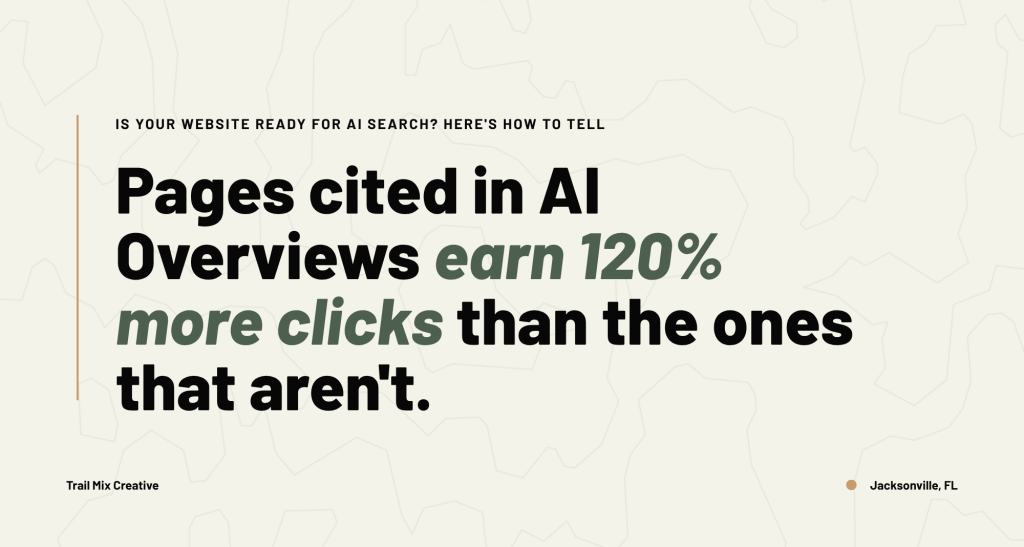
The reason to care is that cited brands capture this upside. Seer Interactive found that pages cited inside AI Overviews earn roughly 120 percent more organic clicks per impression than uncited pages on the same query (Seer Interactive, 2026). Being the source the engine names, not a link buried below the answer, is where the traffic now lives. As Vivek Pandya, Director of Adobe Digital Insights, put it in 2026, AI is “quickly becoming the primary interface between consumers and their favorite brands.”
How to tell if your website is ready for AI search
You do not need a lab to check this. You need about fifteen minutes and a willingness to see what the engines actually say about you. Run these steps in order and write down what you find.
- Ask the engines directly. Open ChatGPT, Google AI Mode, Gemini, and Perplexity. Ask each one what your business does, where it is, and what it offers. If the answers are vague, wrong, or blank, the engines cannot read or trust your site yet.
- Check that bots can reach you. Look at your robots.txt file. Confirm you are not blocking crawlers like GPTBot or PerplexityBot, and confirm your key content shows up when the page loads, not only after scripts run.
- Look for a direct answer up top. On your most important pages, is the core answer stated plainly in the first paragraph, or is it buried under a slider and three intro sentences? Engines pull the clearest passage, not the prettiest one.
- Validate your structured data. Run your pages through Google’s Rich Results Test. Confirm you have schema for your organization, articles, and FAQs, and that every fact in the code also appears on the visible page.
- Check your facts for consistency. Your business name, address, phone number, founding details, and services should match across your site and your off-site profiles. Contradictions make an engine distrust you.
- Confirm your content is quotable. Scan for specific statistics, named sources, and short standalone sentences an engine could lift. Pages built from vague claims rarely get cited.
If steps one, four, and six turn up problems, that is your priority list. You can also run our free website audit tool to see many of these signals scored automatically.
SEO ready and AI search ready are not the same thing
A site can rank well and still lose in AI answers, because the two disciplines reward different things. The table below shows where they diverge. Read it as a gap analysis: anywhere your site only satisfies the middle column, you have work to do.
| Signal | Traditional SEO | AI search readiness (AEO and GEO) |
| Goal | Rank a page high in a list of links | Get your facts quoted and your site cited in one answer |
| Unit that wins | The whole page and its keywords | A single passage that stands on its own |
| What engines reward | Backlinks, keyword relevance, page authority | Clear answers, verified facts, named sources, clean structure |
| Best content shape | Long pages targeting many terms | Direct answers, tables, steps, definitions, FAQs |
| How you measure it | Rankings and organic clicks | Citations, brand mentions in answers, referral traffic from AI |
Most Jacksonville small business sites we audit were built for the left column and never updated for the right. The fix is rarely a rebuild. It is usually restructuring what you already have so engines can parse it, plus adding the facts and schema that earn trust. That work lives at the intersection of our SEO and digital advertising and AI readiness services.
What actually makes an AI engine cite your website
The strongest evidence here is academic, not anecdotal, and as of 2026 it remains the foundational study in this field. In 2024, researchers from Princeton, Georgia Tech, IIT Delhi, and the Allen Institute for AI published “GEO: Generative Engine Optimization” at the KDD conference, the first large study to test what raises a site’s citation rate inside AI answers. They ran 10,000 queries against nine content techniques (Aggarwal et al., KDD 2024).
Three techniques did the heavy lifting. Adding relevant statistics raised citation visibility by about 41 percent. Adding quotations from named sources raised it by about 28 percent. Citing your own external sources helped most for pages that were not already ranking near the top, lifting their visibility by as much as 115 percent (Aggarwal et al., KDD 2024). As the authors put it, these methods can “boost source visibility, with an increase of over 40% across various queries.”
Two things hurt: keyword stuffing and padding. The lesson for a busy owner is refreshingly plain. Say the true thing clearly, back it with a number and a source, and structure it so a machine can find it. Fluff that once filled a page for SEO now works against you.
Accuracy matters more than ever because the engines are not yet reliable narrators. A Columbia University Tow Center study of eight AI search tools across 1,600 queries found they returned incorrect citations more than 60 percent of the time, ranging from 37 percent for the best performer to 94 percent for the worst (Tow Center, Columbia Journalism Review, 2025). When a site states facts clearly and consistently, it gives the engine less room to get your business wrong.
What this means for Jacksonville and Northeast Florida small businesses
For a local business, AI search readiness is largely a trust and clarity problem. When someone in Jacksonville asks an AI assistant for a plumber, a dentist, or a design agency, the engine assembles an answer from the sites it can read and believe. If your hours, service area, and specialties are stated plainly and marked up with schema, you are eligible to be that answer. If they are scattered or contradictory, you are not.
The good news is that local businesses often have less competition inside AI answers than they do in crowded traditional rankings. A clean, well-structured site with consistent facts and a real local footprint can get cited quickly. That starts with the technical foundation, which is why our web design and development work bakes in fast loading, clean markup, and crawlable content from the first build rather than bolting it on later.
How Trail Mix Creative gets your site AI search ready
We have spent more than ten years building brands, and we have shipped over 100 projects for more than 150 businesses, rated 5.0 across more than 50 reviews. That track record matters here because AI readiness is not one fix. It is web, content, structure, and off-site trust working together, which is exactly what our “one team, one plan, one brand” model is built for.
Our process runs in four steps: Discovery in week one, Strategy in week two, Build across weeks three to eight, and Launch and Grow from week nine onward. For AI readiness specifically, that means auditing how engines currently see you, restructuring content for direct answers, adding verified statistics and schema, and monitoring which engines start citing you. Based in Jacksonville and serving clients nationwide, we start every engagement with a free 15-minute consultation and website audit.
If you want to know exactly where your site stands with AI search today, book a free 15-minute consultation and we will walk you through what the engines see and what to fix first.
Frequently asked questions
What is answer engine optimization (AEO)?
Answer engine optimization is the practice of structuring your content so AI engines can pull a direct answer from it and credit your site as the source. In practice that means leading pages with a plain answer, using clear headings phrased as real questions, adding verified statistics and named sources, and marking key facts up with schema. It overlaps heavily with SEO but optimizes for being quoted rather than just being ranked.
How is AI search different from traditional SEO?
Traditional SEO aims to rank your page high in a list of links so a user clicks through. AI search reads multiple pages, writes a single answer, and cites a few sources. The unit that wins shifts from the whole keyword-targeted page to a single passage that stands on its own. You still need strong SEO underneath, but you also need clear answers, consistent facts, and clean structure so an engine can extract and trust your content.
Does schema markup help with AI search?
Yes. Schema markup is code, usually in JSON-LD format, that labels your content so machines know it describes a business, an article, a person, or an FAQ. It gives AI engines a clean, unambiguous set of facts instead of forcing them to guess from your page text. One rule matters most: every fact in your schema must also appear on the visible page. Mismatched or hidden markup can be flagged as spammy and hurt you.
Can AI search engines read my website if it is built in JavaScript?
Sometimes, but not reliably. Many AI crawlers read the HTML that loads first and may not wait for JavaScript to render your content. If your key text, headings, and facts only appear after scripts run, an engine may see a nearly empty page. The safe approach is to make sure your core content is present in the initial page load, then test it by viewing the page source and by asking an AI engine what your page says.
How do I know if ChatGPT or Google AI Overviews are citing my business?
Ask them. Query ChatGPT, Google AI Mode, Gemini, and Perplexity about your business, your services, and questions your customers actually type. Note whether you are mentioned, whether the facts are right, and whether your site is linked. Then watch your analytics for referral traffic from AI domains. Together those two checks tell you whether the engines can find you, trust you, and send you visitors.
How long does it take to make a website AI search ready?
It depends on your starting point, but most sites see meaningful movement within a few weeks rather than months. Structural fixes like direct-answer openings, schema, and fact consistency can be applied fast. Earning citations across more engines builds from there as the content is crawled and trusted. Our typical engagement moves from audit to a restructured, AI-ready build across roughly weeks three to eight, then monitors and grows citations after launch.